
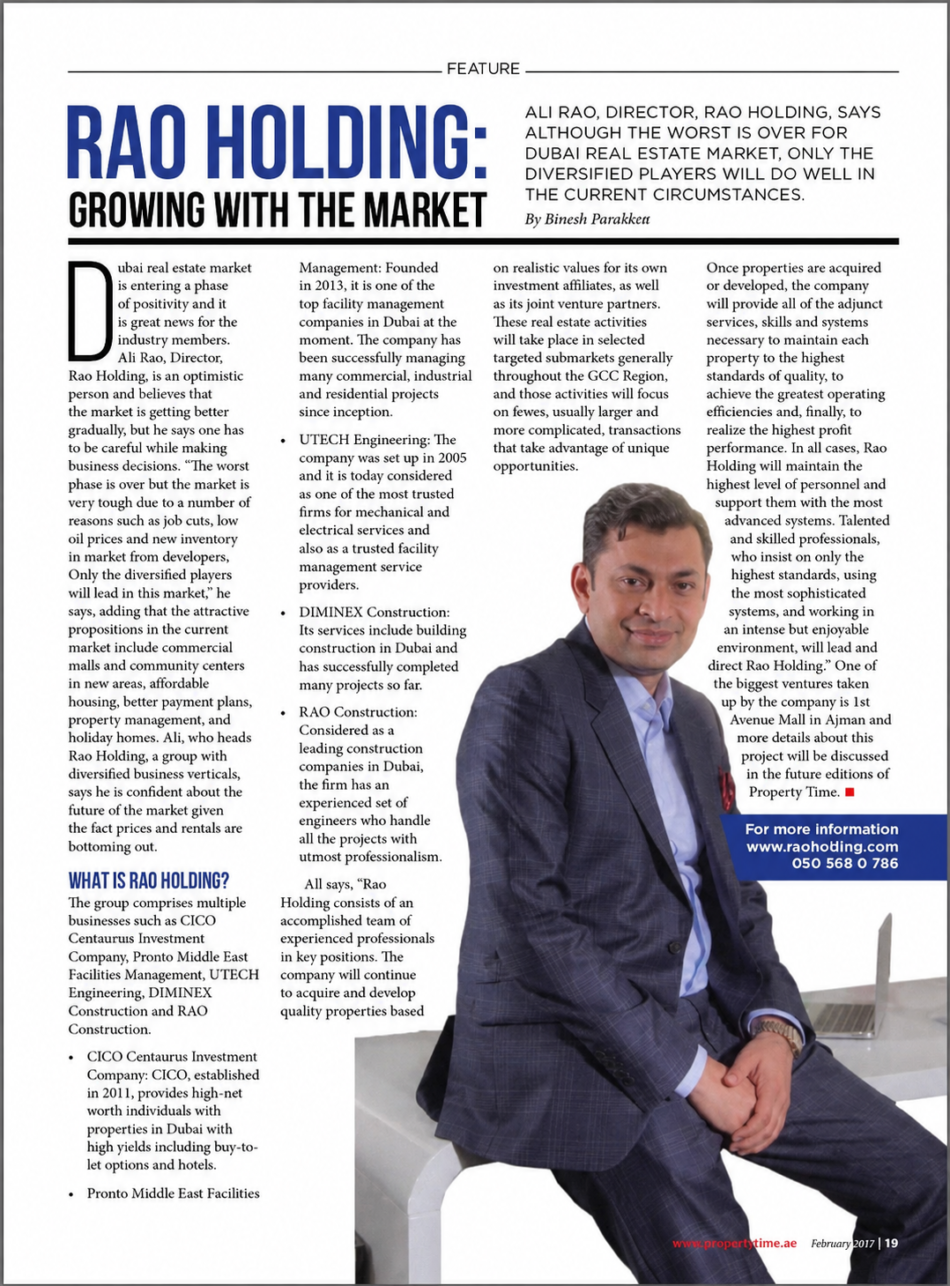
 Back in 2017, with Dubai’s real estate market only just emerging from its toughest stretch in years, I made a point that I still stand behind today: only the diversified players would come out ahead. That wasn’t a market prediction dressed up as insight — it was the operating principle Rao Holding had already been built around for years by that point.
Reading a Market Correctly Means Reading It Without Wishful Thinking
The worst phase was over by 2017, but “over” didn’t mean easy. Job cuts, low oil prices, and a wave of new inventory from developers were all still working against the market at the same time prices and rentals were finally bottoming out. I said then what I still believe now — the operators who survive a market like that aren’t the ones waiting for conditions to turn fully favourable. They’re the ones positioned across enough different verticals that no single headwind can take the whole business down with it.
Why Rao Holding Was Never Built Around One Business
Rao Holding was never a single real estate play. It was a group — CICO Centaurus Investment Company, established in 2011, giving high-net-worth individuals access to high-yield Dubai properties including buy-to-let options and hotel assets. Pronto Middle East Facilities Management, founded in 2013, managing commercial, industrial, and residential projects as one of Dubai’s leading facilities management firms. UTECH Engineering, set up in 2005, trusted for mechanical and electrical services long before “diversification” became a buzzword anyone used. DIMINEX Construction, delivering builds across Dubai. And RAO Construction itself, staffed by engineers who treated professionalism as a baseline requirement, not a differentiator.
Five businesses, five different functions across the real estate value chain — acquisition, facilities management, engineering, construction, and delivery — all under one holding structure. That wasn’t accidental. It was the entire point.
What I Actually Believed the Market Wanted
In a market working through oversupply and softening prices, I saw the real opportunity sitting in specific places: commercial malls and community centres in emerging areas, affordable housing, more flexible payment plans, serious property management, and holiday homes. None of those were glamorous calls. All of them were correct, because they answered what buyers and tenants actually needed in that moment rather than what developers wished they still wanted.
A Philosophy That Outlasted Any Single Deal
Rao Holding’s approach was never about chasing every transaction available. It was about targeting fewer, larger, more complex opportunities across the GCC — the kind of deals that reward genuine expertise rather than volume. Once a property was acquired or developed, the responsibility didn’t end there — maintaining it to the highest standard, running it efficiently, and realizing its full performance was just as much a part of the mandate as the acquisition itself. That’s a philosophy built on talented people, held to serious standards, working with the best systems available. I never saw a reason to compromise on any part of that equation.
One of the largest undertakings from that period — 1st Avenue Mall in Ajman — was still unfolding at the time, a project whose full story deserved more room than a single feature could give it. Looking back, it stands as a fair example of exactly what diversification, applied with discipline, was always meant to produce.


