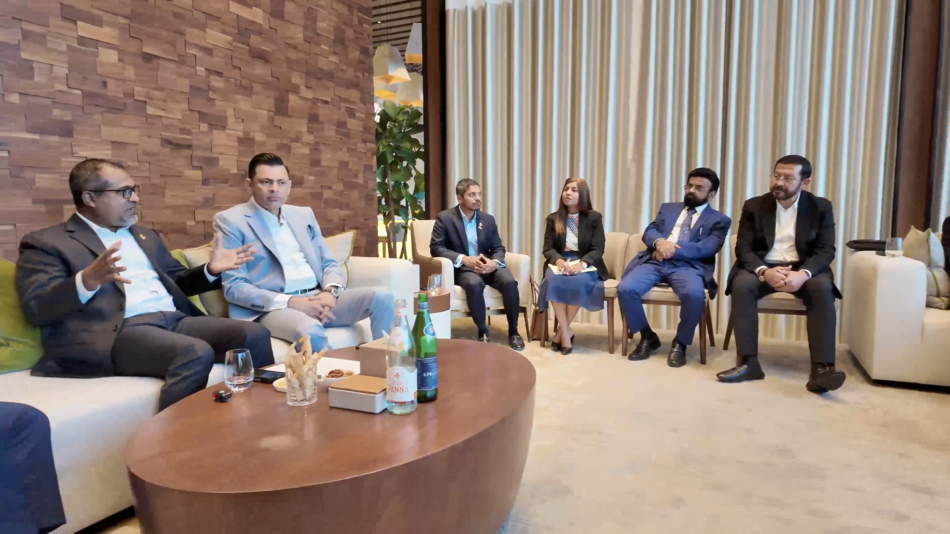
There’s a version of diplomacy people expect — flags, podiums, prepared statements read from a card. The version I actually work in looks different. It looks like a quiet room in Dubai, two delegations, and a conversation that matters more for what gets agreed informally than for anything that ends up in a press release.
A Mandate Beyond Capital Markets
Not everything I do touches real estate or capital markets. Some of it touches something harder to quantify — community. Specifically, the Pakistani diaspora across the Gulf, and the institutional relationships that hold that community together across borders and generations. That’s the mandate I carry as a Board of Governors member of the Overseas Pakistanis Foundation, and I’ve never treated it as a lighter obligation than anything I do in the private sector. If anything, it demands more — because the people it serves rarely have a seat at the table unless someone insists on bringing one.
Sitting Across From Dr. Abdulla Khaleel
This particular meeting brought senior OPF representatives face to face with Dr. Abdulla Khaleel, Maldives’ Foreign Minister, here in Dubai. There was no ceremony to hide behind, no scripted talking points to lean on — just a direct conversation about what a stronger economic relationship between Pakistan and Maldives could actually look like in practice. Where the two countries have genuine room to deepen trade. Where investment could flow that currently doesn’t. Where commercial cooperation has been left on the table simply because no one has sat down long enough to build it.
Why Diplomacy and Commerce Move Together, Not Apart
I’ve never accepted the idea that diplomacy and commerce belong in separate rooms. They move together, or they don’t move at all. A stronger government-to-government relationship means nothing to a business owner in Karachi or Malé unless it actually opens a door he can walk through. That’s the part of this work I care about most — not the handshake, but what the handshake makes possible six months later, when a trade corridor exists that didn’t before, or a business in one country finds a genuine partner in the other instead of working past each other for another decade.
Trust Is the Only Currency That Actually Compounds
Capital, governance, and diplomacy all run on the same underlying currency, and it isn’t money — it’s trust, built one direct conversation at a time, not through communiqués or joint statements but through people willing to sit in a room and say plainly what they actually want from each other. I don’t separate this side of my work from the rest of what I do, because I don’t think trust built in a boardroom and trust built in a diplomatic meeting are actually different things. They’re the same discipline, applied in a different room.
What This Conversation Actually Produced
This was one of those conversations. The business case for a closer Pakistan-Maldives relationship came through clearly in it — not as a talking point, but as something both sides seemed to genuinely want to build toward. I don’t know yet exactly what comes out of a meeting like this in twelve months. I know that meetings like this are where it starts, and I’d rather be in the room helping shape that start than reading about it afterward.